
There’s a new barrier between your business and the revenue that would change everything, and it has nothing to do with your product, your pricing, or your pitch. It’s a stack of compliance certifications that enterprise buyers now require before they’ll sign a contract — and the cost of meeting those requirements can exceed what many women-owned businesses earn in profit all year.
Welcome to the compliance paywall.
What Changed
Five years ago, most enterprise vendor requirements amounted to proof of general liability insurance and a W-9. Today, procurement departments at mid-to-large companies routinely require some or all of:
- SOC 2 Type II certification — a security audit proving your systems protect client data
- Cyber insurance with $2M–$5M in coverage, naming the client as an additional insured
- Written incident response plan that’s been tested via tabletop exercises
- Multi-factor authentication enforced across all systems (96% of cyber insurers now mandate this)
- Endpoint Detection and Response (EDR) tools deployed across all devices (88% of carriers require this)
- Vendor security questionnaires — 50 to 200 questions about your infrastructure, policies, and data handling
These aren’t suggestions. They’re gate requirements. If you can’t check every box, the contract goes to someone who can — regardless of who had the better proposal.
What It Actually Costs
Here’s the math that stops most small businesses cold:
SOC 2 Type II Certification
- First-year cost: $30,000–$80,000 for a small business (audit fees, compliance tooling, internal team time of 100–200 hours)
- Annual renewal: $15,000–$40,000
- Timeline: 6–12 months from start to certification
Cyber Insurance (at enterprise-required levels)
- $2M–$5M coverage policy: $3,000–$15,000/year depending on industry and revenue
- Pre-qualification: 73% of small businesses fail their initial cyber insurance assessment in 2026
- Required security infrastructure to even qualify: $5,000–$20,000 in tooling (MFA, EDR, backup systems)
Compliance Tooling and Infrastructure
- Compliance automation platform: $5,000–$15,000/year
- Security monitoring/EDR: $3,000–$8,000/year
- Managed backup with immutable storage: $2,000–$6,000/year
Total first-year cost to become enterprise-ready: $50,000–$130,000+
For context, the median annual profit for a women-owned business with under 10 employees runs between $40,000 and $80,000. The compliance paywall can cost more than you made last year.
Why This Hits Women-Owned Businesses Harder
This isn’t just a small-business problem. It’s a gendered one — and the math explains why.
Women-owned businesses are concentrated in service sectors — consulting, marketing, healthcare services, tech services, education — that sell directly to enterprise buyers. These are exactly the industries where compliance requirements are escalating fastest.
Women-owned businesses are smaller on average. The median woman-owned business has fewer employees and lower annual revenue than its male-owned counterpart. Compliance costs that represent 5% of a $2M business’s revenue represent 25% of a $400K business’s revenue. Same requirement, different burden.
The compliance paywall creates a catch-22. You need enterprise revenue to afford the certifications. You need the certifications to win enterprise revenue. If you can’t self-fund the compliance infrastructure, you’re locked out of the market segment that would generate the capital to pay for it.
Access to capital compounds the problem. Women business owners already face a documented lending gap — smaller loans, higher rates, more rejections. Borrowing $50K–$100K for compliance infrastructure (with no guaranteed contract on the other side) is a risk most lenders won’t underwrite and most founders can’t stomach.
The Contracts You’re Losing
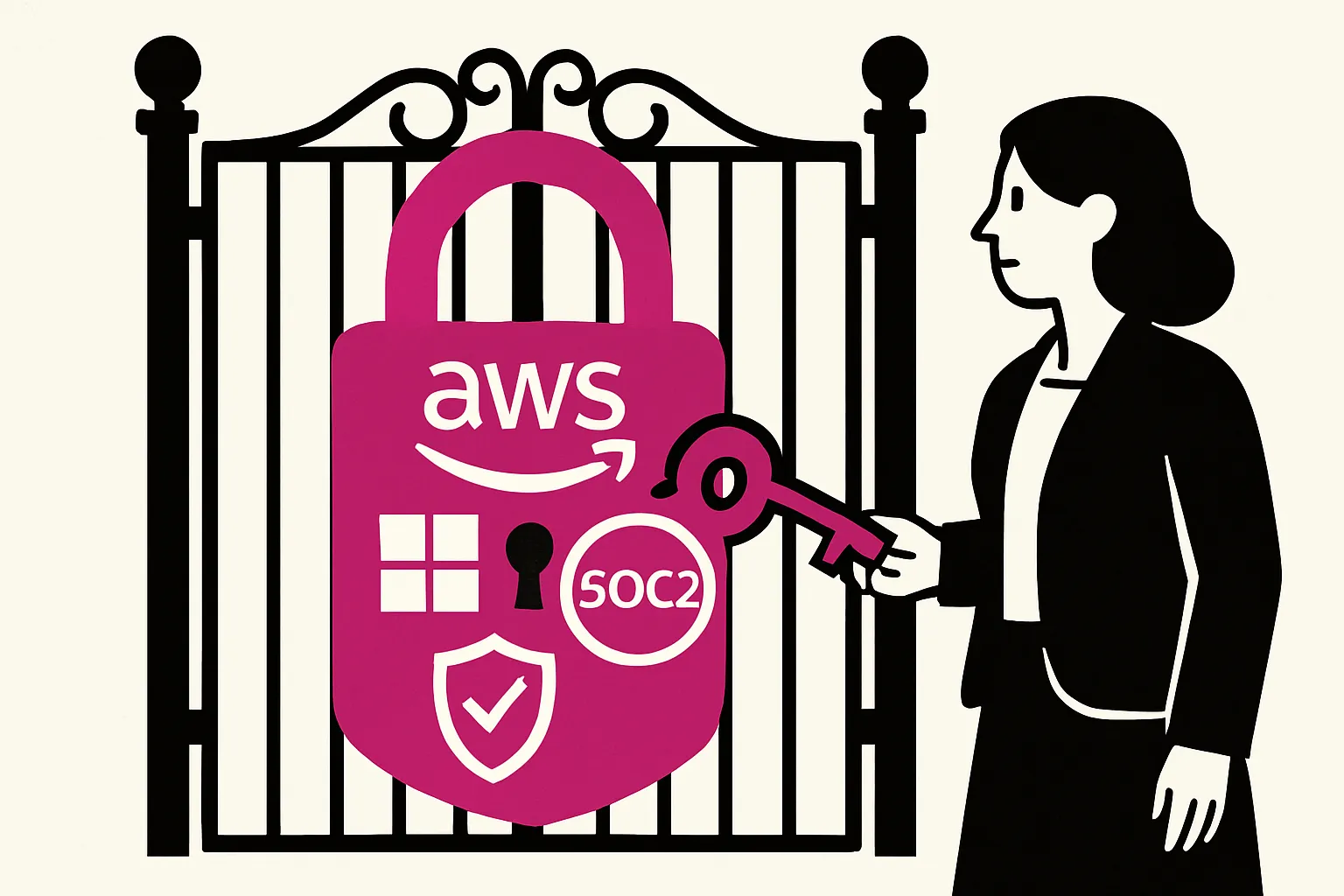
In 2024, 67% of vendors lost contract opportunities due to insufficient compliance coverage. That number is almost certainly higher now — enterprise buyers are tightening requirements, not loosening them.
Here’s what the loss pattern looks like in practice:
- RFP stage: You submit a strong proposal. You’re competitive on price, experience, and references.
- Shortlist: You’re selected as a finalist. Maybe the top choice.
- Vendor onboarding: Procurement sends the security questionnaire and insurance requirements. You have 30–60 days to comply.
- The wall: You don’t have SOC 2. Your cyber insurance maxes at $1M. Your “incident response plan” is a paragraph in your employee handbook.
- The loss: The contract goes to a larger competitor who checks every box — not because they’re better at the work, but because they can afford the compliance infrastructure.
This is the new version of the collateral trap. Instead of lacking assets to secure a loan, you lack certifications to secure a contract.
What You Can Actually Do
The compliance paywall is real, but it’s not binary. Here’s how to approach it strategically instead of treating every requirement as all-or-nothing:
1. Prioritize the highest-ROI certification
If your target clients are in tech, SaaS, or healthcare, SOC 2 is the gatekeeper. If you’re selling to government or defense, it’s CMMC or FedRAMP for government contracts. If your clients are in retail or financial services, it’s PCI DSS. Don’t try to get all certifications at once — identify which one unlocks the most revenue and start there.
2. Use compliance automation to cut costs by 30–50%
Platforms like Vanta, Drata, Sprinto, and Secureframe automate evidence collection, policy management, and continuous monitoring. They reduce the 100–200 hours of internal work that SOC 2 requires and can cut total compliance costs by a third or more. Budget $5,000–$15,000/year instead of hiring a dedicated compliance person.
3. Start with SOC 2 Type I, not Type II
Type I is a point-in-time snapshot. It costs $7,500–$15,000 and can be completed in 2–3 months. It’s not as strong as Type II (which covers a 6–12 month observation period), but many enterprise buyers accept Type I as an interim step while you work toward Type II. This gets you through procurement faster at a fraction of the cost.
4. Negotiate the insurance requirements
When a vendor questionnaire demands $5M in cyber coverage, that number isn’t always fixed. Ask:
- Will you accept $2M with a commitment to increase at renewal?
- Can we provide evidence of security controls in lieu of higher coverage limits?
- Is there a waiver process for vendors below a certain revenue threshold?
You’d be surprised how often procurement requirements are aspirational rather than mandatory — but only if you ask.
5. Build the security stack before you need it
The cheapest time to implement MFA, EDR, and backup systems is before a contract depends on it. Most of the underlying security infrastructure costs $5,000–$15,000/year — far less than the SOC 2 audit itself. Get the foundational controls in place now, and the audit becomes a documentation exercise rather than a rebuild.
6. Explore compliance-as-a-cost in your pricing
Once you have SOC 2 and enterprise-grade insurance, you’ve cleared a barrier that most of your competitors haven’t. That’s a competitive advantage — price it in. Enterprise buyers expect to pay more for vendors who meet their compliance requirements. Your higher cost structure isn’t a weakness; it’s a signal of professionalism.
The Uncomfortable Truth
The compliance paywall isn’t going away. Enterprise cybersecurity requirements will only tighten as breach costs escalate and regulators increase scrutiny. 82% of insurance claims in 2024 involved organizations without MFA — insurers are responding rationally to the data.
But rational for insurers doesn’t mean fair for small businesses. When compliance infrastructure costs as much as a full-time employee, it functions as a regressive tax — easy for large firms to absorb, devastating for small ones. And when women-owned businesses are systematically smaller and less capitalized than their competitors, that tax falls hardest on the businesses least able to pay it.
The question isn’t whether you need to get compliant. You probably do, if enterprise contracts are part of your growth plan. The question is whether you plan for it as a deliberate investment — with a timeline, a budget, and a clear ROI calculation — or whether you discover it as a surprise when the contract you thought you won disappears into procurement.
Plan for it. Budget for it. And stop treating it as overhead — it’s a capital investment in market access, and it should be funded like one.
The compliance paywall is one of several structural barriers that keep women-owned businesses competing in a smaller market than they should be. For Danielle Kwon’s story of breaking through the compliance wall, see Founder Stories. For more on the capital gap, see The Real Numbers: Where Women’s Business Funding Stands in 2026 and The Non-Bank Funding Map.