
On March 1, 2026, the Small Business Administration quietly cut off every lawful permanent resident in America from the single most important small business lending program in the country.
No transition period. No alternative pathway. No acknowledgment that millions of immigrant-owned businesses were about to lose access to the cheapest capital available to small firms.
If you hold a green card and own a business, you are now locked out of SBA 7(a) loans, 504 loans, and disaster loans. If your business partner holds a green card — even if you’re a citizen — your entire company is locked out. If your spouse co-owns the business and hasn’t naturalized yet, locked out.
This isn’t a technicality. It’s a funding cliff. And the businesses tumbling over it are disproportionately owned by women.
What Actually Changed on March 1
The SBA has always had ownership requirements. But before March 2026, lawful permanent residents — green card holders with the legal right to live and work permanently in the United States — were eligible for SBA loan programs. That had been the case for decades.
Here’s the timeline:
- Pre-2026 standard: SBA required at least 51% U.S. citizen or LPR ownership. Green card holders, refugees, and asylees could own up to 100% of a business and still qualify.
- December 2025: The SBA issued updated guidance that would have preserved LPR access to all loan programs — maintaining the status quo that had worked for decades.
- January 2026: The administration reversed course. New policy language began circulating that would require 100% U.S. citizen or national ownership for all SBA lending products.
- March 1, 2026: The rule took effect for the major programs. Every SBA 7(a) loan, 504 loan, and disaster loan now requires 100% U.S. citizen or national ownership. LPRs — people who pay taxes, employ Americans, and hold permanent legal status — are excluded entirely.
- April 1, 2026: The restriction expanded to cover SBA microloans and surety bonds. The last remaining SBA products accessible to LPR-owned businesses disappeared.
The scope is absolute. A business that is 99% owned by a U.S. citizen and 1% owned by a green card holder is ineligible. A business owned by a refugee who’s been in the U.S. for 15 years and employs 30 people is ineligible.
Why the scale matters
SBA 7(a) is the largest government-backed small business lending program in the country. In FY2025, it facilitated over $31 billion in loans. The 504 program provides long-term, fixed-rate financing for major assets. SBA microloans — the program with the best gender parity in all of federal lending — now also exclude LPRs.
This is the sharpest single restriction to SBA eligibility in the program’s modern history. And it was executed without the notice-and-comment rulemaking process that would normally accompany a change of this magnitude.
Who This Actually Hits — and It’s Not Who You’d Expect
The political framing around immigration and business ownership tends to invoke tech startups and venture capital. That’s not who this rule affects.
The businesses losing SBA access are overwhelmingly in the service economy. And they’re disproportionately owned by women.

The industries
- Restaurants and food service. Immigrant women own a disproportionate share of independent restaurants, catering businesses, and food trucks — industries that run on SBA 7(a) financing for equipment, buildouts, and working capital.
- Salons and personal care. Nail salons, hair salons, spas, and beauty businesses are heavily concentrated among immigrant women owners — particularly Vietnamese, Korean, and Latina entrepreneurs.
- Healthcare and home care. Home health agencies, dental practices, physical therapy clinics, and childcare centers — all capital-intensive, all heavily reliant on SBA lending for startup and expansion.
- Retail. Independent clothing stores, grocery markets, specialty shops — the backbone of immigrant commercial corridors in every major metro area.
These aren’t speculative ventures. They’re established businesses with revenue, employees, and tax histories. Many have had SBA loans before. They just lost the ability to get another one.
The numbers
According to analysis from the National Community Reinvestment Coalition, approximately 3.2 million businesses in the United States are owned by immigrants. They generate over $1.3 trillion in annual revenue and employ 8 million American workers.
Immigrant women represent one of the fastest-growing segments of business ownership in the country. They start businesses at higher rates than U.S.-born women. And they’re concentrated in exactly the service sectors most dependent on SBA capital.
A CalMatters investigation into the rule’s impact in California alone found tens of thousands of LPR-owned businesses — many in the state’s restaurant, agriculture, and personal services sectors — facing immediate capital access disruption.
The mixed-ownership trap
This is where the rule gets structurally vicious.
The 100% citizen ownership requirement means that one LPR co-owner disqualifies the entire business. In practice:
- Spousal co-ownership. A citizen and her LPR husband co-own a restaurant. She’s 60% owner, he’s 40%. The entire business is locked out of SBA lending — even though majority ownership is American.
- Partnership structures. Three women co-own a home health agency. Two are citizens, one holds a green card with a naturalization application pending. The business is ineligible.
- Community property states. In California, Texas, Arizona, and other community property states, spousal ownership can be implied by law. An LPR spouse who isn’t even listed on the business may still trigger disqualification depending on how the lender interprets ownership.
The rule doesn’t just affect businesses owned by immigrants. It affects businesses connected to immigrants. The blast radius is far wider than the policy language suggests.
For deeper analysis of how immigration enforcement intersects with women’s banking access, see our coverage of the immigration banking crackdown’s impact on women founders.
Where the Money Goes When SBA Disappears
Here’s what happens when you cut off the cheapest source of small business capital for over a million businesses: those businesses don’t stop needing money. They stop being able to borrow it responsibly.
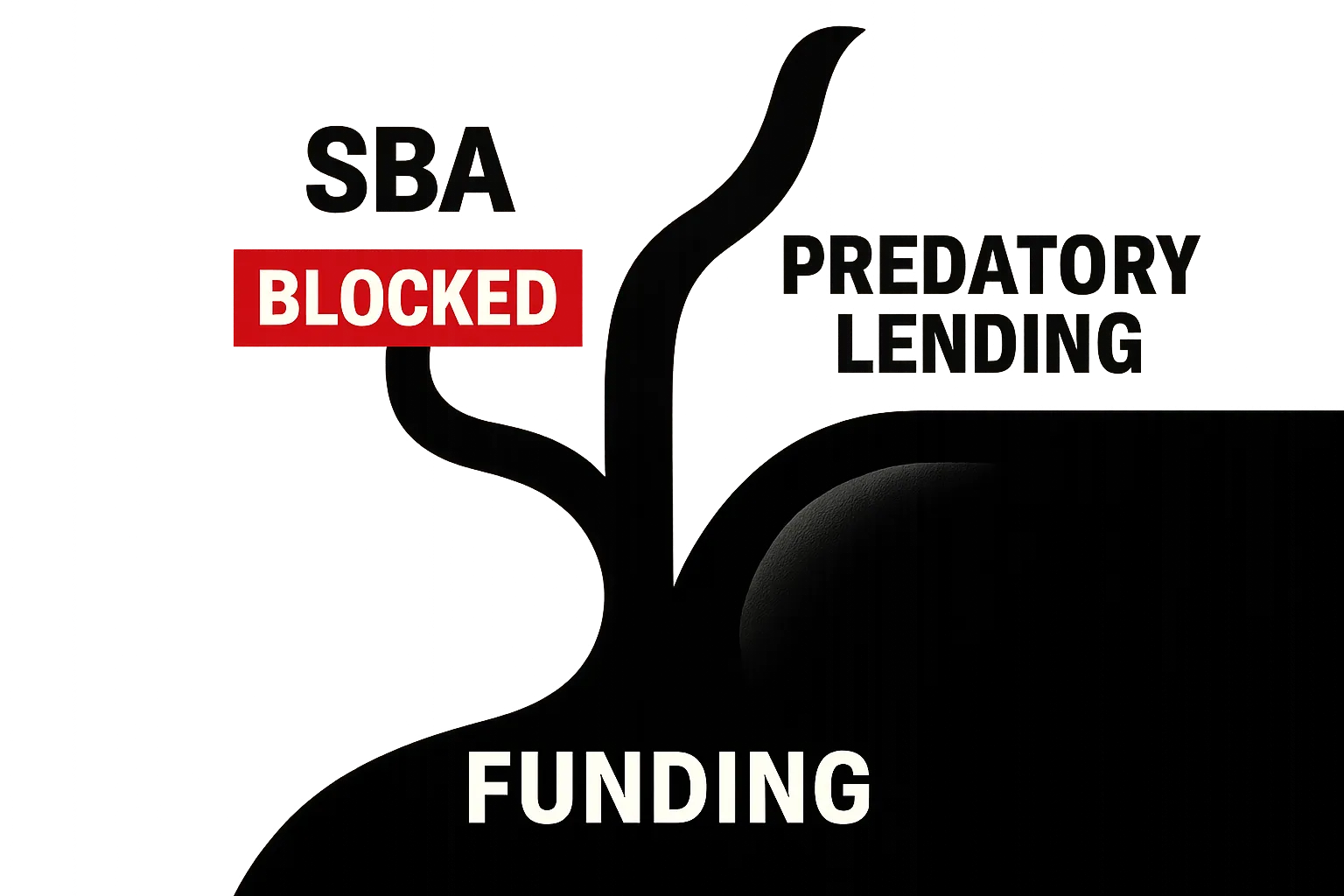
The predatory pipeline
The pattern is predictable because it’s already well-documented in the SBA lending gap analysis:
- SBA denial. Business applies for an SBA loan. Gets rejected on citizenship grounds. No alternative is offered. No referral. Just a letter.
- Bank pullback. Business tries conventional lending. Banks — already cautious in 2026’s rate environment — are tightening underwriting standards for businesses that lost SBA eligibility, because SBA guarantees were what made those loans feasible in the first place.
- The Google search. Owner searches “business loan for green card holder.” The top results are merchant cash advance companies and high-cost online lenders spending $50-$100 per click on exactly those keywords. They approve fast. They don’t ask about citizenship.
- The MCA trap. Business takes a merchant cash advance at 80-350% effective APR. Daily or weekly repayments start immediately, draining working capital. When cash gets tight, the MCA provider offers a “renewal” — a second advance stacked on the first. The debt spiral begins.
This pipeline isn’t new. It’s the same machine that fills the funding dead zone for every underserved borrower segment. The citizenship lockout just fed a million more businesses into the intake funnel.
The fear factor
There’s a dimension of this that doesn’t show up in lending data: LPR business owners who stop applying for anything.
Immigration enforcement escalation in 2026 has created a chilling effect that extends well beyond SBA programs. LPR owners report avoiding banks entirely — not because they’ve been denied, but because they’re afraid that applying and being rejected will create a paper trail. That their financial records will be flagged. That visibility in the formal lending system creates immigration risk.
This fear is not irrational. It’s a documented behavioral response to enforcement-heavy policy environments. And it pushes capital-seeking behavior underground — toward family loans, informal lending circles, and cash-based operations that limit growth and increase vulnerability.
When a business owner is afraid to walk into a bank, the only lenders she’ll encounter are the ones who come to her — through Facebook ads, Instagram DMs, and mailers. Those are never the cheapest options.
Banks tightening simultaneously
The SBA citizenship rule didn’t land in a vacuum. It arrived during a period of broad credit tightening:
- Conventional loan denial rates for small businesses hit 73% in late 2025, according to Federal Reserve Small Business Credit Survey data.
- Regional bank consolidation continues to reduce the number of lenders willing to underwrite small-dollar business loans.
- Post-SVB caution still influences risk appetite, particularly for service-sector businesses operating on thin margins.
For immigrant women owners, the SBA lockout arrived at the exact moment when every other door was also narrowing. The cheapest capital source disappeared, and the remaining options got more expensive and harder to access — all at once.
The informal lending trap
When formal channels close, informal ones open. Community lending circles (tandas, susus, chit funds) have deep roots in immigrant communities and serve real functions. But they have limits:
- No credit reporting — the borrowing doesn’t build the credit history that opens future doors
- No legal protections if something goes wrong
- Amounts are typically small ($2,000-$15,000)
- Can’t finance the $50K-$250K needs that SBA loans were covering
Informal lending isn’t predatory. But it’s not a substitute for institutional capital. Treating it as one keeps businesses small by design.
Your Actual Alternatives — Ranked by Cost and Risk
If you’re an LPR business owner — or a citizen whose business is disqualified because of a co-owner’s immigration status — here’s where legitimate capital still exists. Ranked from lowest cost to highest risk.
1. CDFIs and community banks (best option for most)
Community Development Financial Institutions still serve LPR-owned businesses. They’re not bound by SBA eligibility rules for their non-SBA lending products, and many were created specifically to serve the communities this rule just locked out.
What to know:
- Rates: 6-12% APR, depending on the CDFI and your profile
- Amounts: $5,000 to $250,000+ at some CDFIs
- Timeline: 2-6 weeks for approval — slower than online lenders, dramatically cheaper
- Citizenship: Not required. LPR status is explicitly welcome at most CDFIs
Start with the CDFI lending guide for women, which maps specific CDFIs by region and industry focus. Call before applying to confirm loan ranges and current availability — demand has surged since March.
2. State SSBCI-funded programs
The State Small Business Credit Initiative allocated $10 billion to states for small business lending and investment programs. Many state programs using SSBCI funds have their own eligibility criteria — and some explicitly include LPR-owned businesses.
Key states with active programs serving LPRs:
- California — through IBank and CDFI partners
- New York — through Empire State Development
- Illinois, Texas, Florida — all have launched or expanded programs since the SBA rule change
These are the most underutilized capital sources available right now. Most business owners don’t know they exist. Check your state’s economic development agency directly.
3. Credit unions
Member-owned credit unions offer small business lending products without SBA involvement. They’re community-focused and often more flexible on underwriting than commercial banks.
- Rates typically fall between CDFIs and online lenders
- Relationship banking still matters here — join first, build deposit history, then apply
- Some credit unions have dedicated immigrant entrepreneur programs, particularly in metro areas with large immigrant populations
4. Revenue-based financing and invoice factoring
If your business has consistent monthly revenue or outstanding invoices from creditworthy customers, these products can provide capital without touching the SBA system.
Revenue-based financing: Borrow against future revenue, repay as a percentage of monthly income. Effective APR varies widely (15-40%). Better than MCAs, worse than CDFIs. Read every term — some products marketed as “revenue-based financing” are merchant cash advances wearing a nicer suit.
Invoice factoring: Sell outstanding invoices at a discount (typically 1-5% per month). Works well for B2B businesses with 30-60 day payment cycles. Doesn’t require SBA eligibility or strong personal credit.
5. Navigating the full alternative landscape
The alternative lending market is large, and not all of it is predatory. But finding the right product without guidance is where most business owners make expensive mistakes — especially under the time pressure of lost SBA access.
Lendesca is one resource for navigating alternative lending pathways, particularly for business owners who need help identifying which non-SBA products match their specific revenue profile, industry, and capital needs. The non-bank funding map provides a broader overview of what’s available and what to avoid.
6. When ownership restructuring helps vs. creates worse problems
Some advisors will suggest restructuring ownership to remove the LPR co-owner and regain SBA eligibility. Be very careful here.
When it can work:
- The LPR co-owner holds a small minority stake and is genuinely willing to divest
- The restructuring reflects real business reality, not just a paper change to game eligibility
- You have an attorney reviewing the transfer for tax, liability, and immigration implications
When it creates worse problems:
- Sham transfers. The SBA requires genuine ownership changes. Paper-only transfers to regain eligibility can result in fraud charges, loan recall, and permanent SBA debarment.
- Tax triggers. Ownership transfers can create capital gains events, gift tax obligations, and changes to the business’s tax classification.
- Immigration risk. For LPR owners, divesting from a business they still operate can create inconsistencies between tax filings and immigration records — a red flag during naturalization.
- Community property complications. In community property states, you cannot simply “remove” a spouse from ownership without legal separation or a formal property agreement. Attempting this without counsel is a path to litigation, not lending.
Bottom line: Ownership restructuring is a legitimate tool, but only with a business attorney and a tax advisor in the room. Never restructure based on a lender’s suggestion alone. And never do it in a rush.
The Advocacy Map: What’s Being Challenged and By Whom
The SBA citizenship rule is not going unchallenged. Here’s who’s fighting it, what’s realistic, and where you fit in.
Congressional pushback
Sen. Patty Murray (D-WA) has been the most vocal opponent in the Senate, calling the rule “a solution in search of a problem” that punishes taxpaying business owners legally authorized to live, work, and operate businesses in the United States.
Rep. Judy Chu (D-CA) introduced legislation to restore LPR eligibility for SBA programs, citing the disproportionate impact on Asian American and Pacific Islander-owned businesses and the communities they serve.
Both efforts face steep odds in the current Congress. But they establish the legislative record that future reversals will build on — and constituent pressure is what determines whether those records gather dust or gain co-sponsors.
NCRC analysis and legal challenges
The National Community Reinvestment Coalition published detailed analysis documenting the economic impact: job losses, tax revenue reduction, commercial corridor destabilization, and the downstream effects on communities where immigrant-owned businesses are major employers.
Legal challenges are being explored on multiple fronts — procedural (the lack of notice-and-comment rulemaking), equal protection, and Administrative Procedure Act arguments. The legal path is narrow but not nonexistent. The procedural challenge may be the strongest, since the SBA implemented what amounts to a major rule change through guidance rather than formal rulemaking.
State-level parallel programs
Several states are building workarounds:
- California expanded its Small Business Loan Guarantee Program to explicitly cover businesses that lost SBA eligibility due to the citizenship rule
- New York directed additional SSBCI funds toward immigrant entrepreneur lending programs through CDFI partners
- Illinois launched a targeted initiative through its CDFI network to absorb displaced SBA demand
- Washington and Massachusetts are developing similar state-funded bridge programs
These programs can’t replace the scale of SBA lending — $31 billion is a number no state can match. But they’re providing critical bridge capital while federal policy remains hostile.
What you can do right now
If this affects you or your community, here are five concrete actions — not thoughts and prayers, actions:
- Document the denial. If your business was denied an SBA loan due to the citizenship rule, save that letter. These records become evidence in legal challenges and legislative testimony. They’re also useful when applying to alternative lenders — it shows you were creditworthy enough to apply.
- Contact your representatives. Constituent stories change votes. Call your House member and both senators. Ask specifically about co-sponsoring legislation to restore LPR eligibility for SBA programs. Written letters from business owners with employee counts and tax figures are more effective than form emails.
- Connect with advocacy organizations. NCRC, the National Immigration Law Center, Small Business Majority, and your state’s Small Business Development Center are tracking this issue and collecting impact data. Your story is evidence.
- Apply for alternative capital now. Don’t wait for the rule to be reversed. CDFI applications take weeks, and demand is surging post-March. The businesses that moved first got funded. Those still waiting will find longer queues and tighter availability.
- Get legal advice before restructuring anything. If you’re considering ownership changes to regain eligibility, consult a business attorney and tax advisor first. The wrong restructuring costs more than the capital it’s trying to access.
The Structural Reality
The SBA citizenship lockout is a single policy change. But its damage is structural because it interacts with every other barrier immigrant women business owners already face.
Lower approval rates. Women-owned businesses already face higher denial rates than male-owned businesses. Immigrant women face higher rates still. Removing SBA guarantees from the equation makes the gap worse, not better.
Smaller networks. First-generation business owners have less access to the professional networks — accountants, attorneys, banker relationships — that help navigate complex lending landscapes. When the simple path (SBA) closes, the complex paths require exactly the professional infrastructure they’re least likely to have.
Language barriers. SBA denial letters don’t come with CDFI referrals. The alternative capital landscape is opaque even in English. In Mandarin, Vietnamese, Spanish, or Korean, the information gap is a canyon.
Compounding timelines. Naturalization takes 5-7 years after green card issuance — and processing delays are pushing that longer. That’s 5-7 years of being locked out of the country’s primary small business lending program while paying into the tax system that funds it.
This isn’t about sympathy. It’s about math.
Immigrant-owned businesses generate an estimated $1.3 trillion in annual revenue. They employ 8 million Americans. They pay federal, state, and local taxes. They anchor commercial corridors that would otherwise be vacant storefronts. Cutting them off from the lending infrastructure designed to help small businesses grow doesn’t strengthen the economy. It hands their capital needs to lenders charging 80-350% APR.
The businesses affected by this rule aren’t going to stop operating. They’re going to stop borrowing responsibly. And the cost of that shift — in destroyed credit, failed businesses, lost jobs, and hollowed-out commercial districts — will be paid by communities that can least afford it.
If you know an immigrant woman business owner, send her this article. She may not know the rules changed. And she definitely needs to know where the alternatives are before someone selling a merchant cash advance finds her first.
For more on navigating the lending landscape as a woman business owner, see the gender-lens SBA lending playbook and the full SBA lending gap analysis.