
You ran the numbers twice. Your accountant ran them a third time. Eighteen months of growing revenue, healthy margins, clean books — and the confidence that comes from knowing your business actually works.
Then the email lands: Application Denied.
Not because your financials were weak. Not because your plan didn’t make sense. You got rejected for reasons that never appeared on the application, were never explained in the denial letter, and have nothing to do with whether your business can repay the loan.
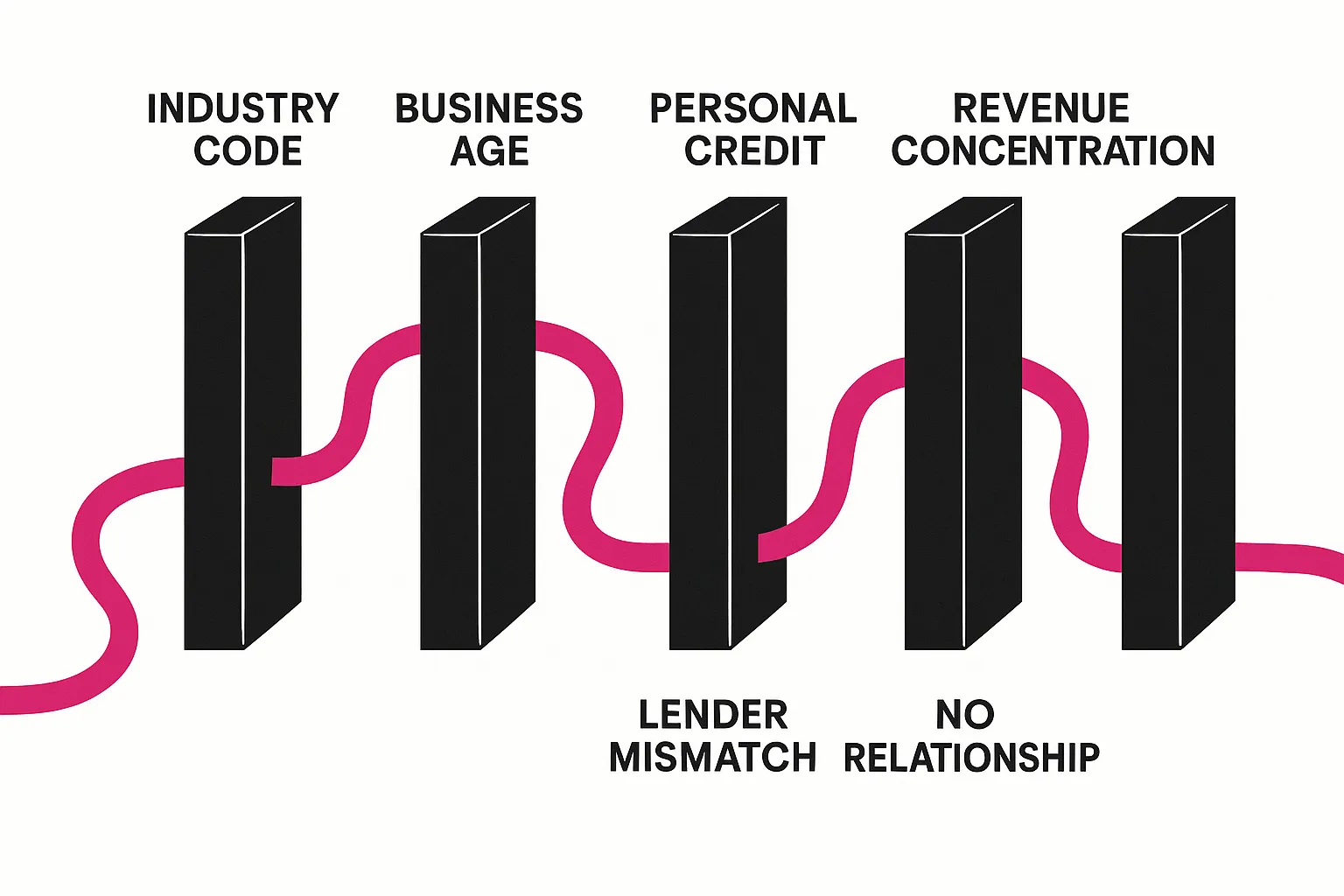
This happens to profitable women-owned businesses every day. The Federal Reserve’s Small Business Credit Survey consistently shows that women business owners receive less funding than men even when controlling for creditworthiness, revenue, and industry. The gap isn’t about your numbers. It’s about six invisible walls between you and approval — walls you can identify, name, and in most cases, tear down before your next application.
Here’s what’s actually blocking you.
Wall 1: Industry Classification Is Working Against You
Your business is a boutique fitness studio that’s been profitable since month eight. You specialize in prenatal and postpartum training with a 94% client retention rate. But the lender doesn’t see that.
They see NAICS code 713940 — “Fitness and Recreational Sports Centers.” That code sits under the broader umbrella of “Arts, Entertainment, and Recreation” (NAICS 71), a sector that includes amusement parks, gambling, and concert venues. Lenders pull industry risk tables that calculate average failure rates for the entire category, not your specific niche.
The same thing happens to specialty food producers lumped under “Food Manufacturing” (NAICS 311), independent consultants classified under broad professional services codes, and aesthetics businesses categorized alongside all “Personal Care Services.”
Your profitability doesn’t override the category’s risk score.
What to do:
- Ask the lender which NAICS code they assigned to your application. You have the right to know, and it’s often wrong.
- Provide industry-specific data showing your subsector’s performance differs from the category average. Trade associations and industry reports are your ammunition here.
- Check whether a different, more accurate NAICS code applies. A prenatal fitness studio could reasonably argue for classification under health and wellness services rather than recreation. A specialty food brand selling direct-to-consumer might fit better under retail than manufacturing.
- Include a one-page industry brief with your application that positions your business within its actual competitive set — not the government’s broad bucket.
Wall 2: Business Age Triggers an Automatic Flag
You launched in 2023. You’ve been profitable for over a year. You have paying customers, recurring revenue, and a trajectory any reasonable person would fund.
But most traditional lenders draw a hard line at two to three years in operation — regardless of profitability. SBA loan programs typically require two or more years for standard 7(a) loans. Many community banks won’t even look at applications under that threshold.
This wall hits women disproportionately hard. Women-owned business formations surged after 2020, meaning a huge percentage of women-owned businesses are still in their first three to five years. You’re being penalized for timing, not performance.
What to do:
- Target lenders that underwrite to 12 months of operating history rather than the standard 24–36. Online lenders and some CDFIs work on shorter timelines.
- Look into SBA Community Advantage loans, which are specifically designed for underserved markets and have more flexible time-in-business requirements.
- Consider a microloan as your first capital injection. Organizations listed through the CDFI Fund offer microloans up to $50K that build your lending history. Repaying a small loan on time creates the track record that unlocks larger funding.
- Document everything from day one. Monthly P&Ls, quarterly reviews, tax returns filed on time — the shorter your history, the more organized it needs to be.
For a deeper breakdown of matching your business stage to the right funding source, see our guide on which lender types actually approve women.
Wall 3: Personal Credit Bleed
Here’s a detail that surprises even experienced business owners: for nearly every business loan under $350K, the lender pulls your personal FICO score. Your business credit score — the one you’ve carefully built with Dun & Bradstreet or Experian Business — might not even be checked.
That means your personal financial history follows you into the business loan office. Medical debt. Student loans. A divorce that cratered your credit three years ago. A single missed payment on a personal credit card during a rough quarter.
Women carry disproportionate burdens in all three of those categories. Medical debt affects women at higher rates. Women hold roughly two-thirds of student loan debt. And divorce proceedings can wreck a personal credit profile for years, even when you weren’t the financially irresponsible party.
Your business books can be flawless, and your personal credit can still kill the application.
What to do:
- Pull both your personal and business credit reports before applying. Know exactly what the lender will see. Use annualcreditreport.com for personal and check Nav or Credit.net for business.
- Dispute inaccuracies immediately. Medical debt reporting in particular is riddled with errors. Disputed items often get removed.
- Give yourself a 90-day runway. Start optimizing your personal FICO at least three months before you plan to apply. Pay down revolving balances below 30% utilization, avoid opening new personal accounts, and make every payment on time.
- Start building business credit proactively so that when you qualify for loans that rely on business credit scores, your profile is ready.
Wall 4: You’re Applying to the Wrong Lender
This is the wall that costs the most time and the most confidence. You apply to your bank — the big national brand where you’ve had a checking account for years — and get denied. You assume the problem is you.
It’s not. It’s the lender.
The numbers tell the story clearly:
- Big banks approve roughly 13% of small business loan applications
- Community banks approve approximately 53%
- Online lenders approve around 61% of women applicants
You didn’t fail the application. You applied to an institution that rejects nearly nine out of ten applicants as a matter of course.

What to do:
- Stop defaulting to your personal bank. A checking account relationship at Chase or Bank of America does not translate into lending access.
- Match your business profile to the right lender type. If you’re under $150K and need speed, online lenders have the highest approval rates. If you want SBA-backed terms, community banks and CDFIs are your path. If you’re over $500K with strong financials, regional banks offer the best combination of approval odds and favorable terms.
- Apply to multiple lender types simultaneously. This isn’t like applying for personal credit cards — multiple business loan inquiries within a 14-day window typically count as a single pull.
- Resources like Lendesca.com map the lending landscape for business owners navigating these walls, helping you match your profile to the lender types most likely to say yes.
For the full breakdown, read our piece on how lending algorithms amplify bias across different institution types.
Wall 5: Revenue Concentration Flags Your Application
Your business does $600K in annual revenue. Healthy. Growing. But $280K of that comes from one client — a corporate contract you’ve held for two years with a signed renewal.
To the lender, that’s not a stable anchor contract. It’s concentration risk. If more than 30–40% of your revenue comes from a single source, most lenders flag the application. Lose that one client, and the loan becomes unrecoverable in their model.
Women in B2B services — consulting, marketing, accounting, staffing — are especially vulnerable here. Building a business on one to three strong client relationships is a smart growth strategy. It’s also a lending red flag.
What to do:
- If you have time before applying, diversify. Even adding two or three smaller clients that bring your top client below the 30% threshold changes the math.
- If you can’t diversify in time, provide contractual evidence. Multi-year agreements, auto-renewal clauses, historical retention data — anything that proves the concentration is stable, not fragile.
- Frame it strategically in your application. Don’t let the lender discover the concentration in your financials. Address it upfront with context: “Our largest client represents 35% of revenue under a three-year contract with two remaining years, and we have a 100% renewal rate across all contracts.”
- Consider invoice factoring or revenue-based financing for your first round. These lenders evaluate your receivables directly and are less sensitive to concentration since they’re lending against specific invoices.
Wall 6: You Have No Banking Relationship With the Lender
Some denials come down to something frustratingly simple: the lender doesn’t know you. You have no deposit history with them, no existing credit product, no relationship manager who’s seen your account activity.
Banks lend to people they know. A business checking account with six months of consistent deposits tells a loan officer more than a perfect application from a stranger. Internal applicants — borrowers who already bank at the institution — get approved at significantly higher rates than external walk-ins.
Women are more likely to bank at large national institutions where they have a personal account but no business relationship. That personal checking account at Wells Fargo doesn’t help when their small business lending division has never seen your name.
What to do:
- Open a business account at your target lender 3–6 months before you plan to apply. This is the single most underrated move in small business lending.
- Build deposit history. Route your business revenue through the account. Consistent deposits — even if they’re modest — demonstrate cash flow in a way that bank statements from another institution can’t match.
- Ask for a business credit card first. A small credit line with on-time payments builds an internal lending relationship without the stakes of a full loan application.
- Get to know the branch manager or business banking officer. Relationship lending is still alive at community banks and credit unions. A five-minute introduction today can be the difference between approval and denial six months from now.
Read our full guide on building a banking relationship before you need a loan for a step-by-step timeline.
The Post-Denial Action Framework
If you’ve already been denied, don’t spiral. Get strategic.
Every lender is required by the Equal Credit Opportunity Act (ECOA) to provide specific reasons for denial. Not a vague “we’ve decided not to move forward.” Actual reasons. If you didn’t get them, request them in writing.
Then match the reason to the wall and take action:
- Get the denial reason in writing. Call the lender. Cite ECOA. They must tell you.
- Identify which wall blocked you:
- “Industry risk” → Wall 1. Reclassify and reapply.
- “Insufficient time in business” → Wall 2. Target a different lender type.
- “Personal credit” → Wall 3. Optimize and reapply in 90 days.
- “Debt service coverage” or vague capacity concerns → Wall 4. You’re at the wrong lender.
- “Revenue concentration” → Wall 5. Diversify or document stability.
- “No existing relationship” → Wall 6. Open an account and rebuild.
- Fix the specific issue. Don’t shotgun applications. Address the wall.
- Reapply to a better-matched lender. Not the same one. A different institution whose approval profile matches your business.
For the full post-denial playbook — including appeal letter templates and reapplication timelines — see the full post-denial playbook.
The Bigger Picture
None of these six walls are explicitly gendered. No lender writes “denied because applicant is a woman” on a rejection letter. But every single one of them — industry classification bias, business age thresholds, personal credit entanglement, lender type mismatch, concentration risk, and relationship banking gaps — affects women business owners at disproportionate rates.
The system wasn’t designed to exclude you. It was designed without considering you. The result is the same.
But the fix isn’t to be a better applicant. Your application was already strong. The fix is to understand the architecture of lending decisions and position yourself where the walls aren’t. That means choosing the right lender, preparing the right documentation, building the right relationships, and knowing exactly why you were denied so you never hit the same wall twice.
Your P&L was never the problem. Now you know what is.